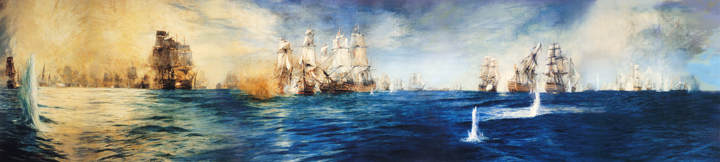
Wyllie's 42' x 12' Panorama of the Battle of Trafalgar.
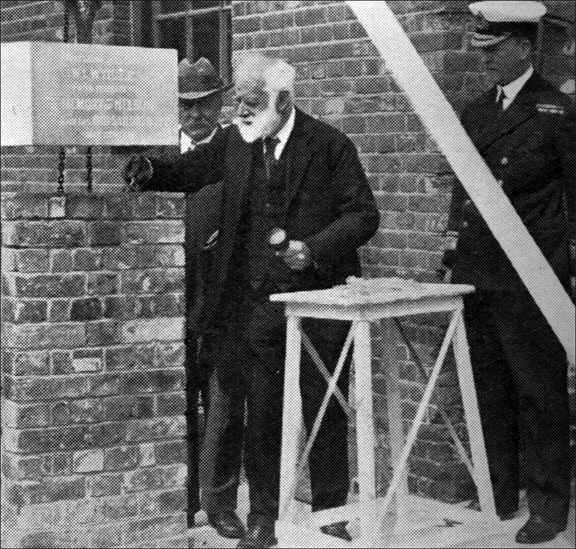
Wyllie laying the apse foundation stone.
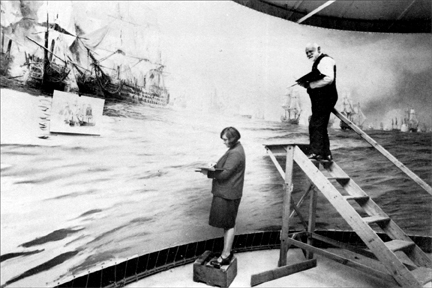
Wyllie and his daughter Aileen painting the Panorama.
'This, the dream of my life, has come to pass'.
At the age of 79, Wyllie began his largest work, and perhaps this picture above all others, is the work that Naval personnel and local people remember him for - The Panorama of the Battle of Trafalgar, a huge oil measuring 42' x 12', taking up the whole of a room that had been specially built to house it, in what was then the Dockyard, but is now part of the Royal Naval Museum. The origins for this great work lie in a letter written by Sir Roger Keyes, then the Commander-in-Chief, Portsmouth, to the Secretary of the Admiralty on 17th December 1928. In that letter an offer from Wyllie was reported to paint the panorama as his gift to save the Victory if the Admiralty would loan £700 to build an apse onto an existing rigging shed near to the King's Stairs, to house the painting. (Wyllie had got the idea for the panorama from a similar work that he had seen of the Battle of Waterloo, that was exhibited in Belgium on the centenary of that battle.) The loan for the extension was to be repaid from the expected takings from ticket sales when the panorama was opened to the public. Sir Roger stressed in his letter that,
'In my opinion, it is highly desirable to take immediate advantage of Mr. Wyllie's generous offer. Mr. Wyllie is an elderly man and despite his unimpaired skill and remarkable vigour of mind and body, there can remain only a rapidly diminishing period of time during which he could undertake a work of such magnitude'.
On 17th July 1928, King George V was due to visit the Dockyard to view the restored Victory. In an inspired piece of direction, Admiral Donaldson, a personal friend of Wyllie, suggested that he should construct a model of the panorama and place it in the Pescot Frost Museum, which the King always visited. Wyllie made a beautiful water-colour sketch of the envisaged scene and mounted and stretched it on a semi-circle of plywood.. This model was made to be viewed through a scale model of the stern of the French warship, Neptune. As planned, the King saw the model and was most enthusiastic to see the completion of the proposed panorama, and offered to come and open the finished work. The loan was forth coming and by 1929 the walls of the new apse were four feet from ground level and Wyllie was asked to lay a commemorative stone.
Wyllie’s 'Panorama of the Battle of Trafalgar' is one of the last important works of this kind still intact. Painted in 1929 by the seventy-nine year old artist, assisted by his daughter Aileen, it has long been regarded as his masterpiece. But, by the late 1990’s it was beginning to show signs of age. Museum staff decided that the major refurbishment of the Victory Gallery offered an ideal opportunity to remove the Panorama for extensive, expert conservation, but the painting was so large that it posed complex problems for the conservators. Financial backing from the Society for Nautical Research enabled the Museum to enlist the services of accomplished restorers.
The DVD ''HMS Victory and the Panorama of the Battle of Trafalgar' graphically illustrates the saving of H.M.S. Victory & the history & restoration of the Panorama.

